|
Books & BBQ Wines for Daddy
Tio Pepe – A Blast from the past
 Michael
Vaughan Michael
Vaughan
Friday, June 13, 2008
Welcome to Friday First
First, here’s something to whet your dad’s intellectual appetite for Father’s Day. There’s nothing like relaxing and digging into a book to explore your favourite wine or spirit.  For browsers, try The Oxford Companion to Wine (third edition) edited by Jancis Robinson an indispensable addition to one's library. This hefty, heavy wine companion, you will find the answer to almost everything here in a somewhat dry, concise manner. In 800+ pages, detail-after-detail is methodically organized from A to Z. If you are looking for wine recommendations, there aren't any. Also, the 70+ maps are quite appalling. Nevertheless, this desperately needed update of the 1999 edition is as good as it gets. It is available on the Chapters-Indigo website for $47.03 vs. the $75 list price. For browsers, try The Oxford Companion to Wine (third edition) edited by Jancis Robinson an indispensable addition to one's library. This hefty, heavy wine companion, you will find the answer to almost everything here in a somewhat dry, concise manner. In 800+ pages, detail-after-detail is methodically organized from A to Z. If you are looking for wine recommendations, there aren't any. Also, the 70+ maps are quite appalling. Nevertheless, this desperately needed update of the 1999 edition is as good as it gets. It is available on the Chapters-Indigo website for $47.03 vs. the $75 list price.
 Those wanting more user-friendly information on these wine regions, try Tom Stevenson's 4th edition of The Sotheby's Wine Encyclopedia, which is available on the Chapters-Indigo website for $37.62. Stevenson's text is integrated with detailed maps, along with labels and extensive producer recommendations. It puts the wine into an immediately comprehensible context. Those wanting more user-friendly information on these wine regions, try Tom Stevenson's 4th edition of The Sotheby's Wine Encyclopedia, which is available on the Chapters-Indigo website for $37.62. Stevenson's text is integrated with detailed maps, along with labels and extensive producer recommendations. It puts the wine into an immediately comprehensible context.
 Sadly, some of the updates from the Mitchell Beazley Classic Wine Library tend to make for pretty drab reading, unless you happen to be a wine writer. The “fully revised and updated (2006) edition” of The Wines of Spain by Julian Jeffs is impersonal, unexciting and, at times, superficial. The cover indicates the price as being $38.95 CAN but it goes for $24.42 on-line at Chapters. Also from Mitchell Beazley, is the infinitely more interesting/readable, updated edition of John Radford's The New Spain: A Complete Guide to Contemporary Spanish Wine. The jacket says $50 CAN but it’s only $27.59 on-line at Chapters. Buy the latter. Sadly, some of the updates from the Mitchell Beazley Classic Wine Library tend to make for pretty drab reading, unless you happen to be a wine writer. The “fully revised and updated (2006) edition” of The Wines of Spain by Julian Jeffs is impersonal, unexciting and, at times, superficial. The cover indicates the price as being $38.95 CAN but it goes for $24.42 on-line at Chapters. Also from Mitchell Beazley, is the infinitely more interesting/readable, updated edition of John Radford's The New Spain: A Complete Guide to Contemporary Spanish Wine. The jacket says $50 CAN but it’s only $27.59 on-line at Chapters. Buy the latter.
 I recently met with James Ewart, the California winemaker who is responsible for the very juicy, plummy, cherry flavouved Gnarly Head 2005 Cabernet Sauvignon (68924) along with the smooth, spicy, slightly honeyed, ripe lemon-melon-pear flavoured Gnarly Head 2006 Chardonnay (68932) both at $16.95. These are perfect crowd-pleasing examples of the types of wine that appeal to dads sweating behind the bbq. The focus: accessibility and quaffability. The white is best consumed fairly well chilled, while the red might also benefit from a hint of cool. Be careful, the wines weigh in with 14.5% alcohol. I recently met with James Ewart, the California winemaker who is responsible for the very juicy, plummy, cherry flavouved Gnarly Head 2005 Cabernet Sauvignon (68924) along with the smooth, spicy, slightly honeyed, ripe lemon-melon-pear flavoured Gnarly Head 2006 Chardonnay (68932) both at $16.95. These are perfect crowd-pleasing examples of the types of wine that appeal to dads sweating behind the bbq. The focus: accessibility and quaffability. The white is best consumed fairly well chilled, while the red might also benefit from a hint of cool. Be careful, the wines weigh in with 14.5% alcohol.
Don’t forget next week’s Wines of Spain Trade Tasting, which happens Tuesday, June 17 from 2:00 to 5:00 pm at The Great Hall, Hart House, University of Toronto - 7 Hart House Circle. For info contact Christopher Martin at 905-206-0577 or email cmartin@fayeclack.com. To celebrate, I am featuring one of my features from the past - with my photograph of a mouse perched on a ladder sipping cool Oloroso, which I took while visiting Jerez in May 2004.
Mice in Gonzalez Byass
Sherry Heaven
A dry white standout in a sea of sweeties
Michael
Vaughan
This is the unexpurgated article that was originally prepared for publication in the National Post. It appeared on June 5, 2004. I wrote a weekly wine & spirits column from 1999 until February 2008 - nine years. As I no longer exist on the National Post website, you will be able to find the full searchable reference library of some 400 features at the www.FBTI.org website. Current updated information is shown in red.
Jerez de la Frontera can be hot, and I mean hot. Last week I attended the 4th biennial edition of Vinoble, the world’s largest trade exposition of sweet wines. Producers from more than 120 wine regions around the world were strutting their wares. Canada’s sole participant, Niagara-on-the-Lake’s Pillitteri Estates found their stand under siege, running out of icewine before the exposition came to an end.
Over four days it seems that I tasted hundreds of sweeties, but just a fraction of what was being poured. I also took in more than a dozen tasting seminars. Wanting to survive, I was able to practice the art of expectoration - the polite word for spitting.
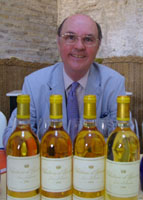 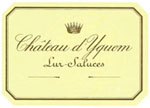 Naturally, there were lapses when things actually got swallowed. For instance, at the tasting of Château d’Yquem led by Count Alexandre de Lur Saluces, who has been the managing director since 1968, we explored the differences between the 1998, 1996, 1988 and 1985 vintages. The former, 1998 Chateau d’Yquem (994277 - $198 half bottle) has just been released in the Classics Catalogue and I was amazed at the wonderful sweet concentration of ripe fruit and how well it is showing - a must buy for anyone pursuing great Sauternes. Currently there are 6 vintages of Yquem available at Vintages in various sizes (13 skews). By contrast, in Quebec, the SAQ has 13 different vintages (48 skews). Naturally, there were lapses when things actually got swallowed. For instance, at the tasting of Château d’Yquem led by Count Alexandre de Lur Saluces, who has been the managing director since 1968, we explored the differences between the 1998, 1996, 1988 and 1985 vintages. The former, 1998 Chateau d’Yquem (994277 - $198 half bottle) has just been released in the Classics Catalogue and I was amazed at the wonderful sweet concentration of ripe fruit and how well it is showing - a must buy for anyone pursuing great Sauternes. Currently there are 6 vintages of Yquem available at Vintages in various sizes (13 skews). By contrast, in Quebec, the SAQ has 13 different vintages (48 skews).
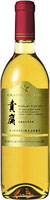 The most surprising highlight of Vinoble, however, turned up at the session on Japanese sweet wines, where I discovered Grande Polaire 1994 Hokkaido Yoichi Noble Rot. This wondrously rich, honeyed, butterscotch flavoured deep gold elixir had remarkable length and acidity, especially for the Kerner grape. When I asked for “more please” I was informed that the cupboard was bare and that this one and only effort currently fetches 30,010 Yen (about $400) per 750 ml bottle. The most surprising highlight of Vinoble, however, turned up at the session on Japanese sweet wines, where I discovered Grande Polaire 1994 Hokkaido Yoichi Noble Rot. This wondrously rich, honeyed, butterscotch flavoured deep gold elixir had remarkable length and acidity, especially for the Kerner grape. When I asked for “more please” I was informed that the cupboard was bare and that this one and only effort currently fetches 30,010 Yen (about $400) per 750 ml bottle.
It took some 40 hand-harvested clusters of botrytised Kerner grapes to produce a single bottle. They were grown in the Yoichi region of northern Japan and made by the Katunuma winery, which was a former brewery and is now owned by Sapporo. Unfortunately, local conditions over the past decade have not permitted a repeat, at least in this area.
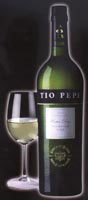 Naturally, the unending seminars combined with the heat started to take its toll. As the palate began to flag and I retreated to the Gonzalez Byass booth for my daily sip or two or three of chilled Gonzalez Byass Tio Pepe (on the LCBO General List at $15.95 - 242669). Naturally, the unending seminars combined with the heat started to take its toll. As the palate began to flag and I retreated to the Gonzalez Byass booth for my daily sip or two or three of chilled Gonzalez Byass Tio Pepe (on the LCBO General List at $15.95 - 242669). 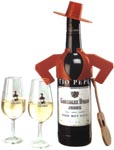 This king of Fino is bracingly dry, gently chalky, dusty, dried lemon flavours provided just the right amount of refreshing deep palate cleansing enabling me to continue. With 15.5% alcohol, it goes well with almost anything throughout a meal - a truly wonderful hot day pick-me-up. It is so good that it was one of only three wines to attain a perfect 100-point score in wine expert Andrés Proensa’s 360-page just-released 2004 Spanish wine buying guide! This king of Fino is bracingly dry, gently chalky, dusty, dried lemon flavours provided just the right amount of refreshing deep palate cleansing enabling me to continue. With 15.5% alcohol, it goes well with almost anything throughout a meal - a truly wonderful hot day pick-me-up. It is so good that it was one of only three wines to attain a perfect 100-point score in wine expert Andrés Proensa’s 360-page just-released 2004 Spanish wine buying guide!
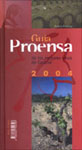 Naturally it was hard hanging around their booth so long without absorbing some of the folklore. I discovered, for instance, Tio Pepe’s dark heavy “Fino muy seco” bottle acquired its famous Andalucian costume – red jacket and wide-brimmed sombrero - in the 1920s. In 2001, almost 80 years later, Tio Pepe got a new wardrobe, a lighter bottle and a new label. The new modern look was accompanied by slightly lower alcohol (now 15.5%) and a perhaps a fresher taste. Naturally it was hard hanging around their booth so long without absorbing some of the folklore. I discovered, for instance, Tio Pepe’s dark heavy “Fino muy seco” bottle acquired its famous Andalucian costume – red jacket and wide-brimmed sombrero - in the 1920s. In 2001, almost 80 years later, Tio Pepe got a new wardrobe, a lighter bottle and a new label. The new modern look was accompanied by slightly lower alcohol (now 15.5%) and a perhaps a fresher taste.
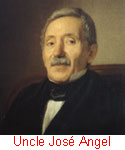 I also found out that Tio Pepe or “uncle Joe” was created in 1844 using the white Palamino grape, which is unique to Jerez. It seems that José Gonzalez Angel would lay away a few special casks of the finest Fino (the palest, lightest, driest and perhaps most elegant of Sherry styles). His uncle Manuel, who founded the Gonzalez Byass firm at the age of 23 just 9 years earlier, decided to name it after José calling it Tio Pepe. I also found out that Tio Pepe or “uncle Joe” was created in 1844 using the white Palamino grape, which is unique to Jerez. It seems that José Gonzalez Angel would lay away a few special casks of the finest Fino (the palest, lightest, driest and perhaps most elegant of Sherry styles). His uncle Manuel, who founded the Gonzalez Byass firm at the age of 23 just 9 years earlier, decided to name it after José calling it Tio Pepe.
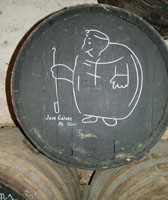 I also discovered that not only is Tio Pepe the world’s most sought after Sherry, but also that their enormous splendid bodegas in the heart of Jerez draw more visitors than any other winery in the world. Some 250,000 climb aboard the various coloured trains to tour the bodegas annually, where tours are offered in four languages. Despite the remote location, it gets more than twice as many visitors as Mondavi in the Napa Valley. I also discovered that not only is Tio Pepe the world’s most sought after Sherry, but also that their enormous splendid bodegas in the heart of Jerez draw more visitors than any other winery in the world. Some 250,000 climb aboard the various coloured trains to tour the bodegas annually, where tours are offered in four languages. Despite the remote location, it gets more than twice as many visitors as Mondavi in the Napa Valley.
Last Sunday I decided to take the 2 pm tour, which charges an extra 4 Euros over the 8 Euro entry fee for an added tasting of some Iberian ham and cheese along with – you guessed it – Tio Pepe. It was while touring the very last bodega, where I discovered what might well be the secret that has made the tour such a success.
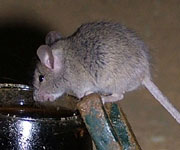 It seems that back in the 1920’s the one of the bodega’s workers, José Galvés, inadvertently dropped some crumbs of bread on the floor while having lunch in the cool dark cellar. All of a sudden some resident mice appeared to nibble up every morsel. Just as he got into the habit of sharing, he discovered that the mice also had a taste for Sherry when some inadvertently spilled on the floor. It seems that back in the 1920’s the one of the bodega’s workers, José Galvés, inadvertently dropped some crumbs of bread on the floor while having lunch in the cool dark cellar. All of a sudden some resident mice appeared to nibble up every morsel. Just as he got into the habit of sharing, he discovered that the mice also had a taste for Sherry when some inadvertently spilled on the floor.
Perhaps it was love at first sight, but it wasn’t long before it became a daily ritual. He tried to teach them some tricks and built a small ladder leaning against a glass filled with their favourite elixir - a sweeter, older, amber coloured Oloroso. In no time at all the mice discovered that they could climb the ladder and get a drink whenever they felt the urge.
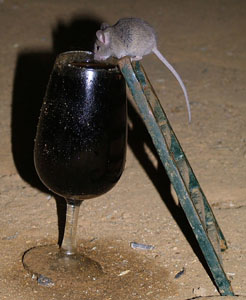 To this day, the routine continues - providing some three dozen happy cellar rodents the privilege of not only being fed daily in the cool of the bodega, but also getting their ration of one of the world’s finest wines. The original tiny ladder still sits there leaning against the glass, while the mice perform for astonished visitors. While the mice don’t seem to mind all the tourists, trying to get them to pose for a photo proved to be a bit of a challenge. Thankfully, I found one cooperative mouse, who was obviously enjoying himself and didn’t mind my advances. In the end, it’s as if they had died and gone to Sherry heaven – after all, how many mice do you know are able to sip their own new bottle of Oloroso each and every week? To this day, the routine continues - providing some three dozen happy cellar rodents the privilege of not only being fed daily in the cool of the bodega, but also getting their ration of one of the world’s finest wines. The original tiny ladder still sits there leaning against the glass, while the mice perform for astonished visitors. While the mice don’t seem to mind all the tourists, trying to get them to pose for a photo proved to be a bit of a challenge. Thankfully, I found one cooperative mouse, who was obviously enjoying himself and didn’t mind my advances. In the end, it’s as if they had died and gone to Sherry heaven – after all, how many mice do you know are able to sip their own new bottle of Oloroso each and every week?
|
|